
The Complete Story of Hafsah bint Umar ibn Al-Khattab
Introduction
In Islamic history, (RA) stands as a distinguished woman whose life was deeply woven into the fabric of early Islam. As the daughter of Umar ibn Al-Khattab (RA), Islam’s second caliph, and one of the wives of Prophet Muhammad (PBUH), her devotion, courage, and intellectual commitment shaped her role in the Muslim community.
Her significant contributions in preserving the Qur’an, narrating Hadith, and the key moments of her marriage and personality continue to inspire, making this article a reflection of her timeless narrations and influence on early Islam.
Personality and Character of Hafsah bint Umar ibn Al-Khattab
Hafsah bint Umar ibn Al-Khattab (RA) was a woman of remarkable strength, wisdom, and faith. She inherited her courage and determination from her father, Umar ibn Al-Khattab (RA), the second Caliph of Islam, who was known for his justice and steadfastness in faith.
From an early age, Hafsah bint Umar embraced the message of Islam with sincerity, showing deep love for the words of Allah. Her calm and disciplined nature reflected a strong belief and purposeful devotion to Allah’s guidance.
She remained devoted to memorizing the Qur’an, taking on the responsibility of safeguarding its initial written compilation after the Prophet’s time. Her careful attention to the holy text showed how much she valued knowledge and truth. To me, her example is not just historical—it’s deeply personal, reminding us how faith and perseverance can preserve the very heart of Islam.
Role of Hafsah bint Umar ibn Al-Khattab in Islam
The Qur’an holds a sacred place in Islamic history, and Hafsah bint Umar played a crucial role in its preserving after the Prophet’s passing. Under the guidance of Caliph Abu Bakr (RA), companions compiled the holy text from various writings and memorized verses, creating a complete compilation. This precious record was later entrusted to Hafsa for safekeeping, a sign of her reliability and faith.
During the Caliphate of Uthman ibn Affan (RA), the manuscript preserved by Hafsah bint Umar ibn Al-Khattab (RA) served as the primary source for compiling a unified and standardized Qur’an.
Her vital role as the custodian of the Qur’an highlights her deep dedication to Islam and her honor in safeguarding Allah’s words and divine message. This immense responsibility given to Hafsah bint Umar stands as a testament to her spiritual strength, trustworthiness, and respected position in Islamic history.
The verse,
beautifully mirrors her life’s mission. As I reflect on her story, I find inspiration in how she carried the weight of divine preservation, ensuring that the Qur’an reached future generations in its pure form.
Marriage of Hafsah bint Umar ibn Al-Khattab
Before her marriage, Hafsa experienced great loss when her first husband, Khunais ibn Hudhafah, died from injuries sustained in battle. This period of grief revealed her patience and deep faith. Soon after, she married Prophet Muhammad (PBUH), forming a sacred union that strengthened ties between the Prophet and her father Umar (RA), creating a bond of respect and love within the early Muslim society.
As one of the Mothers of the Believers, Hafsa had a unique opportunity to observe and learn directly, gaining knowledge from the Prophet that she later passed down to the Muslim community.Her closeness to the Prophet offered her not only spiritual guidance but also a role in preserving his teachings for generations to come.
Her marriage reflects Allah’s purpose for companionship, beautifully described in the verseوَمِنْ ءَايَٰتِهِۦٓ أَنْ خَلَقَ لَكُم مِّنْ أَنفُسِكُمْ أَزْوَٰجًۭا لِّتَسْكُنُوٓا۟ إِلَيْهَا وَجَعَلَ بَيْنَكُم مَّوَدَّةًۭ وَرَحْمَةً (Surah Ar-Rum, 30:21). This divine message reminds us that marriage is more than a bond—it is a reflection of مَّوَدَّةًۭ (affection) and وَرَحْمَةً (mercy), qualities that Hafsa lived and shared through her life.
Hadiths Narrated by Hafsah bint Umar ibn Al-Khattab
Hafsa (RA) greatly contributed to the preservation of the Prophet’s teachings through her narrating hadiths that highlighted significant aspects of Islamic practice, especially in worship and spirituality. Her narrations not only emphasize the Prophet’s habit of fasting on specific days but also reflect the importance of maintaining regular devotion to Allah.
One of her most well-known hadiths records, “The Messenger of Allah used to fast on Mondays and Thursdays” (Sunan Abu Dawood, 2436). This simple yet profound statement gives us a glimpse into the daily discipline and worship of Prophet Muhammad (PBUH). It also shows how faith was practiced through consistent actions rather than grand rituals.
To me, her hadiths remain a valuable resource for Muslims who wish to align their practices with the Sunnah of the Prophet Muhammad (PBUH). Each narration carries wisdom that bridges the past and present, reminding believers that true spirituality lies in consistency and sincerity of worship.
Divorce and Reconciliation of Hafsah bint Umar ibn Al-Khattab
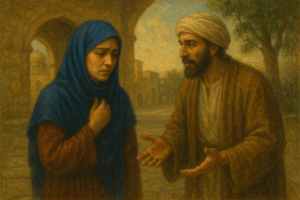
At one point, the Prophet (PBUH) considered divorcing Hafsa after a personal disagreement, showing that even noble relationships face trials. However, Angel Jibreel brought a message from Allah, advising the Prophet to reconcile with her and praising her devotion to prayer and fasting. This moment revealed the deep spiritual bond that existed between them, grounded in faith and sincerity.
The incident highlights the value of forgiveness, patience, and mutual respect in marriage. Through her steadfastness, Hafsa became a reflection of the Qur’anic call to seek help from Allah during hardships. Her calm endurance serves as a timeless example for those who choose compassion over conflict.
The divine verse,
, meaning “O you who have believed, seek help through patience and prayer; indeed, Allah is with the patient,” beautifully connects to her story. It reminds me that faith, when paired with patience and prayer, can heal even the deepest rifts.
Conclusion
Legacy of Hafsa bint Umar (RA)
Hafsah bint Umar ibn Al-Khattab (RA) was a remarkable woman known for her resilience, knowledge, and deep faith. Her vital role in preserving the Qur’an and narrating Hadiths of Prophet Muhammad (PBUH) reflects her dedication to Islam and its teachings. The inspiring story of Hafsah bint Umar motivates Muslims to strengthen their faith and spiritual growth with sincerity and devotion.